IS MEC A GOOD CHOICE AFTER CLASS 10 IF YOU WANT TO BECOME AN IAS OFFICER?
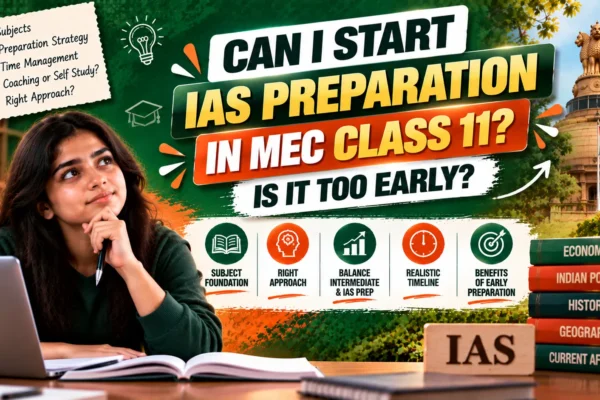
IS MEC A GOOD CHOICE AFTER CLASS 10 IF YOU WANT TO BECOME AN IAS OFFICER?
Choosing an Intermediate stream after Class 10 can feel like a major decision, especially when you already have a long-term ambition such as becoming an IAS officer.
Students interested in civil services often wonder whether they should choose MEC, MPC, CEC or another stream. One common question is: Is MEC a good choice after Class 10 if I want to become an IAS officer?
The short answer is yes, MEC can be a useful academic choice for an aspiring civil servant, particularly for students who are interested in economics, mathematics, commerce, current affairs and analytical subjects.
However, choosing MEC does not automatically give someone an advantage in the UPSC Civil Services Examination. Your Intermediate stream is only one part of a much longer academic journey.
Let’s understand where MEC can help and what students should realistically focus on after Class 10.
WHAT IS MEC AFTER CLASS 10?
MEC generally refers to the combination of:
- Mathematics
- Economics
- Commerce
It is commonly chosen by students interested in economics, business, finance, management and related higher-education pathways.
For a student thinking about civil services in the long term, MEC can also help develop numerical ability, economic understanding and analytical thinking.
There is one key aspect you should understand first:
You do not have to study MEC to become an IAS officer.
Students from different academic backgrounds can eventually appear for the UPSC Civil Services Examination once they meet the required eligibility conditions.
DOES YOUR CLASS 11 STREAM MATTER FOR AN IAS CAREER?
No.
There is no requirement that an aspiring IAS officer must study MEC, MPC, Humanities or any particular Intermediate stream.
The UPSC Civil Services Examination requires candidates to hold a recognized graduate degree or equivalent qualification, subject to the eligibility conditions applicable to the examination.
Therefore, your Class 11 and 12 stream does not determine whether you can eventually attempt UPSC.
This means students should avoid choosing MEC simply because they believe it is compulsory for IAS preparation.
Instead, consider whether the subjects match your interests, academic strengths and possible degree options after Intermediate.
HOW CAN MEC HELP A FUTURE IAS ASPIRANT?
Although MEC is not a requirement for UPSC, some of the skills developed through the stream can be useful later.
1. ECONOMICS BUILDS AWARENESS OF HOW THE COUNTRY FUNCTIONS
Economics introduces students to concepts related to markets, development, income, employment, public finance and the broader economy.
For a student interested in public administration or civil services, understanding how economic decisions affect society can gradually build useful awareness.
At the Intermediate level, the objective should not be to study economics only from a UPSC perspective. Instead, focus on developing strong conceptual understanding.
2. MATHEMATICS DEVELOPS ANALYTICAL THINKING
Mathematics encourages students to approach problems systematically.
Regular practice can strengthen:
- Logical reasoning
- Numerical ability
- Data interpretation
- Problem-solving
- Accuracy
- Time management
These are useful academic skills regardless of whether a student eventually attempts UPSC or chooses another competitive examination.
3. COMMERCE PROVIDES EXPOSURE TO FINANCIAL CONCEPTS
Commerce introduces students to business and financial concepts.
While these subjects do not directly represent the complete UPSC syllabus, they can help students understand how organisations, markets and financial systems function.
This creates a broader academic foundation that may be useful in higher education as well.
DOES MEC COVER THE UPSC SYLLABUS?
Not completely.
This is an important factor to consider when deciding your academic direction.
The UPSC Civil Services Examination covers a much wider range of subjects and skills. An Intermediate MEC curriculum should therefore not be treated as direct UPSC preparation.
Instead, MEC can provide an academic foundation, while students gradually develop other habits separately.
For example, an aspiring civil servant will eventually need broader awareness of areas such as history, geography, governance, society, current affairs and other subjects relevant to the Civil Services Examination.
These areas can be developed progressively rather than trying to complete the UPSC syllabus during Classes 11 and 12.
SHOULD YOU START UPSC PREPARATION IN CLASS 11?
Students do not need to begin intensive UPSC preparation immediately after Class 10.
At this stage, building the right habits is often more useful than studying advanced UPSC material.
A Class 11 or 12 student interested in civil services can focus on:
- Reading newspapers regularly
- Following important national and international developments
- Improving English comprehension
- Developing a reading habit
- Learning basic Indian history, geography and civics
- Practising logical and analytical thinking
- Participating in debates and discussions
- Improving written and verbal communication
- Learning to form balanced opinions based on evidence
These habits can build a foundation without putting unnecessary examination pressure on students too early.
MEC VS OTHER STREAMS FOR AN IAS ASPIRANT
There is no single Intermediate stream that guarantees success in UPSC.
Different streams develop different strengths.
MEC may suit students interested in mathematics, economics, business and analytical subjects.
Humanities or Arts-related combinations may provide earlier exposure to subjects such as history, political science, geography or sociology, depending on the curriculum.
MPC can be suitable for students interested in mathematics, science, engineering and technical degree options while still keeping civil services open as a future career path.
The better choice depends on what you enjoy studying and what undergraduate options you may want to pursue.
Your UPSC journey does not have to be decided entirely at age 15 or 16.
WHAT CAN YOU STUDY AFTER MEC IF IAS IS YOUR LONG-TERM GOAL?
MEC keeps several undergraduate pathways available.
Depending on eligibility requirements of individual universities, students may consider degrees in areas such as:
- Economics
- Commerce
- Business Administration
- Management
- Finance
- Mathematics
- Law
- Public Administration and related disciplines
Your graduation subject does not need to be chosen only on the basis of UPSC.
A sensible approach is to select a degree that interests you and also gives you a meaningful alternative career path.
WHAT SHOULD AN IAS ASPIRANT FOCUS ON DURING INTERMEDIATE?
If you are studying MEC and have an early interest in civil services, use these two years to build a strong academic and personal foundation.
FOCUS ON YOUR INTERMEDIATE SUBJECTS
Do not compromise your board preparation because of a distant competitive examination.
Build strong fundamentals in Mathematics, Economics and Commerce first.
DEVELOP A READING HABIT
Read beyond textbooks.
Quality newspapers, explainers, biographies, history, economics and general-interest books can gradually improve your understanding of the world around you.
UNDERSTAND CURRENT AFFAIRS INSTEAD OF MEMORISING THEM
Simply remembering headlines is not enough.
Try asking:
What happened? Why did it happen? Who is affected? What are the different viewpoints?
This habit encourages analytical thinking.
IMPROVE COMMUNICATION SKILLS
Civil services preparation eventually requires candidates to understand complex topics and communicate ideas clearly.
Writing summaries, participating in discussions and practising public speaking during Intermediate can help develop these skills early.
STAY CURIOUS
You don’t need to know the entire UPSC syllabus in Class 11.
Understanding why governments make certain decisions, how the economy works, how institutions function and how social issues affect people can be a much better starting point.
IS MEC THE BEST STREAM FOR IAS?
There is no universally “best” Intermediate stream for becoming an IAS officer.
MEC can be a good option when the student genuinely enjoys Mathematics, Economics and Commerce and wants to develop analytical and economic understanding.
A student who dislikes these subjects should not choose MEC only because of an IAS ambition.
The stronger strategy is:
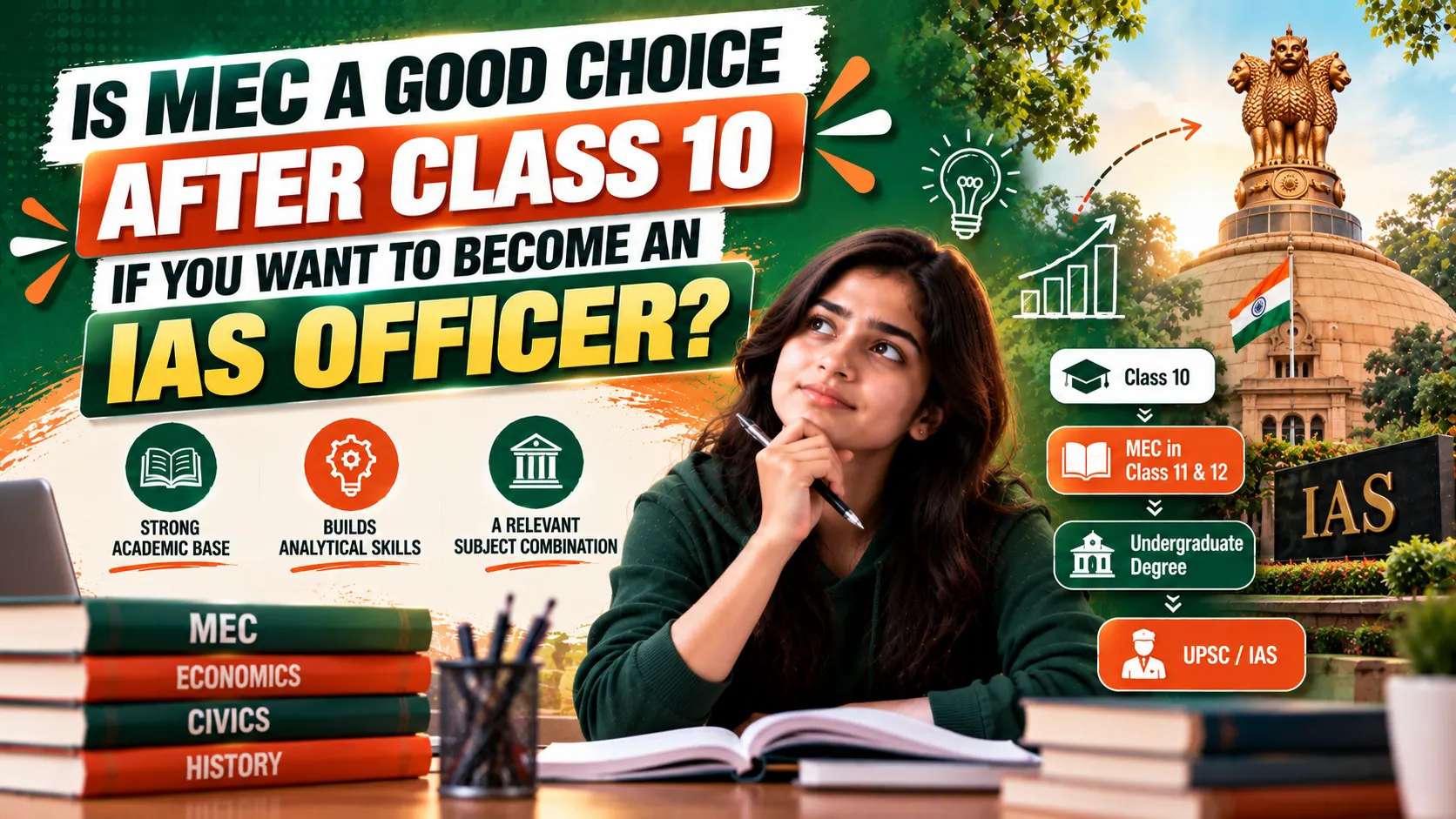
Choose an Intermediate stream that suits your strengths → perform well academically → build reading and awareness habits → choose a suitable graduation path → prepare seriously for UPSC when the time is appropriate.
PLANNING INTERMEDIATE AFTER CLASS 10?
Explore Gyanville’s Intermediate programmes and take the GSAT
for an opportunity to earn a scholarship of up to ₹1,00,000 based on your
performance.
FINAL THOUGHTS
Choosing MEC after Class 10 can be a sensible option for students who are interested in Mathematics, Economics and Commerce and also have a long-term interest in civil services.
But becoming an IAS officer is not determined by your Intermediate stream.
Your reading habits, academic foundation, awareness of society, analytical ability, communication skills and later UPSC preparation will matter far more.
So rather than asking only “Which stream is best for IAS?”, ask a more useful question:
“Which stream will help me understand concepts better, perform well academically and develop skills that benefit me in the long run?”
If MEC matches those goals, it can be a strong starting point for the journey ahead.

You may also like
WHAT CAREER OPTIONS ARE AVAILABLE AFTER MEC WITH IAS?