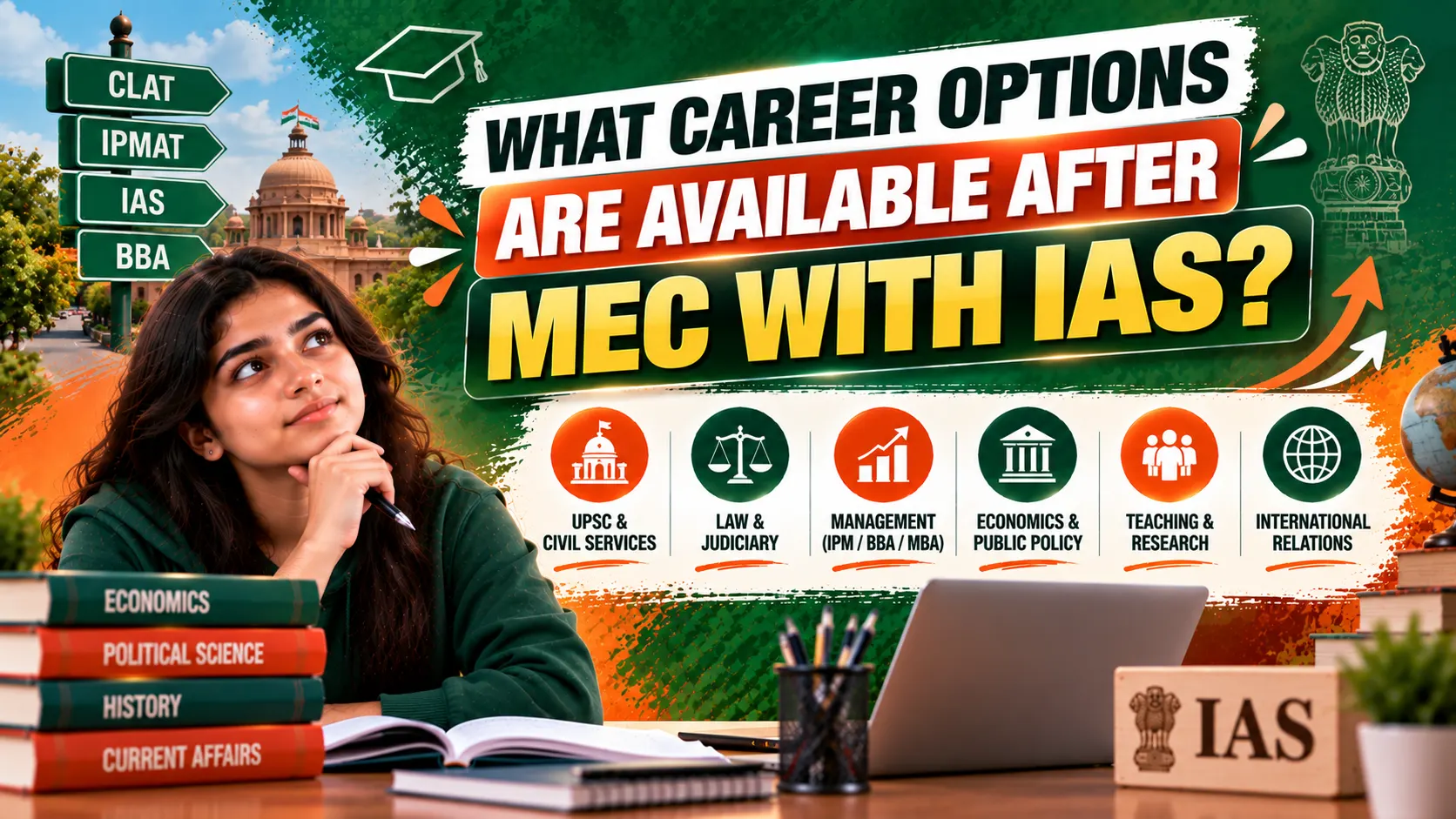
WHAT CAREER OPTIONS ARE AVAILABLE AFTER MEC WITH IAS?
WHAT CAREER OPTIONS ARE AVAILABLE AFTER MEC WITH IAS?
Choosing MEC after Class 10 can open more career paths than many students initially expect. While some students choose Mathematics, Economics and Commerce because they are interested in business or finance, others may select MEC while developing a long-term interest in civil services.
But what happens if your plans change?
Does choosing MEC with an IAS-focused foundation mean you have to become a civil servant?
No.
MEC can provide a flexible academic base for higher education and careers across economics, commerce, management, finance, law, banking, entrepreneurship and other fields. An early interest in IAS can remain one possible direction rather than becoming your only career option.
Let’s explore the major opportunities available after completing MEC.
WHAT DO YOU STUDY IN MEC?
MEC generally includes three core areas:
- Mathematics
- Economics
- Commerce
Together, these subjects help students develop numerical ability, economic understanding, commercial awareness and analytical thinking.
Students who also build a foundation in current affairs, communication and general awareness during Intermediate may develop additional skills useful across higher education and competitive examinations.
The combination can therefore support several possible directions after Class 12.
1. CIVIL SERVICES
For students who continue to be interested in becoming an IAS, IPS, IFS or another civil servant, MEC can serve as an early academic foundation.
However, students should understand that completing MEC does not make them immediately eligible for the UPSC Civil Services Examination.
The usual academic journey involves completing Intermediate and then pursuing a recognized undergraduate degree before becoming eligible under the applicable UPSC requirements.
During graduation, students can decide whether they want to pursue serious Civil Services preparation.
This means there is plenty of time after Class 12 to evaluate whether civil services still matches your interests.
2. ECONOMICS
Students who enjoy understanding markets, economic development, public policy, employment, inflation and financial systems may consider higher education in economics.
Depending on individual university eligibility requirements, possible courses can include programmes such as:
- BA Economics
- BSc Economics
- Economics-related undergraduate programmes
Higher studies can lead towards careers involving economic research, policy, analytics, consulting, financial services and other related fields.
Economics can also be useful for students interested in understanding public policy and development.
3. COMMERCE
Commerce is another natural direction after MEC.
Students interested in accounting, taxation, finance and business operations can explore undergraduate commerce programmes.
Common options include:
- B.Com
- B.Com Honours
- B.Com Finance
- B.Com Accounting
- Other specialized commerce programmes
Course names and admission requirements vary between universities, so students should check the eligibility criteria of individual institutions before applying.
Commerce graduates can later explore opportunities in accounting, banking, finance, taxation, corporate services and related sectors.
4. BUSINESS AND MANAGEMENT
Students who are interested in leadership, entrepreneurship, marketing or managing organisations can consider business and management programmes.
Options may include:
- BBA
- BMS
- Integrated management programmes
- Other undergraduate business courses
Students can later specialize in areas such as finance, marketing, operations, analytics, human resources or entrepreneurship.
For students who eventually want to build businesses or enter corporate management, this can be a suitable direction to explore.
5. INTEGRATED MANAGEMENT PROGRAMMES
Students interested in management immediately after Class 12 can also explore integrated management programmes offered by participating institutions.
Admission processes differ between institutions and may involve entrance examinations, academic requirements and additional selection stages.
This route can appeal to students who develop an early interest in business and management rather than waiting until after graduation to pursue postgraduate management education.
6. CHARTERED ACCOUNTANCY
Students interested in accounting, auditing, taxation and financial reporting may explore Chartered Accountancy.
CA is a professional qualification rather than a regular undergraduate degree, and its structure and requirements are governed by the relevant professional body.
Students considering this path should understand the examination stages, practical training requirements and commitment involved before deciding.
For someone who enjoys working with numbers and financial information, it can be a career path worth exploring.
7. COMPANY SECRETARY
Company Secretary is another professional path students from a commerce-oriented background may consider.
The field involves areas related to corporate governance, compliance and company law.
Students interested in how companies are regulated and administered may explore this route after understanding its current eligibility and examination requirements.
8. COST AND MANAGEMENT ACCOUNTING
Students interested in cost management, financial planning, accounting and business decision-making can also explore Cost and Management Accounting.
Like CA and CS, this is a professional pathway with its own qualification structure.
Students should compare the nature of CA, CS and CMA rather than choosing solely based on popularity.
9. LAW
MEC students are not limited to commerce and management careers.
Law can also be an option after Class 12, subject to the eligibility and admission requirements of individual institutions.
Students interested in areas such as:
- Constitutional law
- Corporate law
- Public policy
- Legal research
- Litigation
- Judiciary
- Governance
may consider an undergraduate law programme.
A background that develops economics, reasoning and general awareness can also provide useful context for students interested in legal studies.
10. BANKING AND FINANCIAL SERVICES
Banking is another field MEC students may explore after completing the appropriate higher education.
Possible areas can include:
- Retail banking
- Corporate banking
- Financial services
- Credit analysis
- Insurance
- Investment-related services
- Financial operations
Different roles have different qualification requirements, so students should view banking as a broad sector rather than a single career.
11. DATA AND BUSINESS ANALYTICS
Students who enjoy Mathematics and working with data may eventually explore analytics-oriented careers.
Depending on the degree and additional technical skills acquired, possible areas can include:
- Business analytics
- Financial analytics
- Market research
- Data analysis
- Economic research
Students interested in this direction may benefit from developing skills in spreadsheets, statistics, data visualization and relevant digital tools during higher education.
12. ENTREPRENEURSHIP
Not every MEC student has to pursue a traditional job.
Students interested in creating products, services or businesses may eventually explore entrepreneurship.
Commerce can introduce business concepts, economics can help students understand markets, and mathematics can strengthen numerical decision-making.
However, entrepreneurship also requires practical skills such as communication, customer understanding, financial planning, adaptability and problem-solving.
13. GOVERNMENT CAREER OPPORTUNITIES BEYOND IAS
Civil services are only one part of the broader public-sector career landscape.
After completing the required educational qualifications, students may explore various recruitment examinations conducted for government departments, public-sector institutions, banking and other services.
Eligibility differs significantly between examinations and roles.
Students should therefore check the official notification for the particular examination they plan to attempt rather than assuming MEC itself provides eligibility.
WHAT IF YOU PREPARE FOR IAS BUT LATER CHANGE YOUR MIND?
Changing your career goal is normal.
A student may be interested in becoming an IAS officer in Class 11 but discover an interest in economics, law, management, finance or entrepreneurship during college.
That does not mean the earlier effort was wasted.
Skills developed while building a civil-services foundation such as reading, communication, current-affairs awareness, analytical thinking and understanding social issues can remain useful across many careers.
Your career plan can evolve as you learn more about your strengths and interests.
HOW SHOULD YOU CHOOSE A CAREER AFTER MEC?
Instead of choosing a career only because it is popular, consider four questions.
WHAT SUBJECTS DO YOU ENJOY?
If economics interests you more than accounting, an economics-related degree may deserve consideration.
If you enjoy business and leadership, management may be more relevant.
If you enjoy law, governance and debate, legal education may be worth exploring.
WHAT ARE YOUR STRENGTHS?
Consider whether your strengths are more numerical, analytical, communicative, creative or managerial.
Your strongest abilities can help narrow down suitable options.
WHAT TYPE OF WORK INTERESTS YOU?
Ask yourself whether you would prefer to:
- Work in government
- Join the corporate sector
- Work with finance
- Study economics
- Enter law
- Manage organisations
- Build a business
- Work with data
Thinking about the nature of the work can be more useful than focusing only on job titles.
WHAT IS YOUR BACKUP PLAN?
Having a long-term IAS ambition is perfectly reasonable, but civil services preparation is highly competitive.
Students should also develop a degree and career pathway that can stand independently.
A strong alternative career plan gives you flexibility rather than limiting your future to a single examination.
A SIMPLE CAREER ROADMAP AFTER MEC
Your journey does not have to be complicated.
Class 11-12
Build strong MEC fundamentals, communication skills, reading habits and general awareness.
↓
After Class 12
Choose a degree or professional programme based on your interests and eligibility.
↓
During Graduation
Develop career-specific skills and explore internships, projects, competitive examinations or professional qualifications.
↓
After/During Graduation
Decide whether civil services, higher education, professional qualifications, corporate employment or another career direction fits your goals.
The important point is that MEC keeps multiple possibilities open.
Start Your Intermediate Journey with GSAT
Still deciding where MEC could take you? Begin your Intermediate journey at Gyanville and put your academic ability to the test through GSAT. Your performance could earn you a scholarship of up to ₹1,00,000.
FINAL THOUGHTS
MEC does not lock you into a single career.
If you currently dream of becoming an IAS officer, you can gradually build the awareness and learning habits that may support that goal. At the same time, Mathematics, Economics and Commerce can provide a foundation for several other higher-education and career paths.
The key is to avoid making your entire career depend on one examination.
Use your Intermediate years to understand your strengths, explore different professions and develop transferable skills.
By the time you complete Class 12, you should not only be asking “Can I become an IAS officer?”
You should also have a clearer answer to:
“What other careers match my interests, abilities and long-term goals?”
That gives you something even more valuable than one fixed career plan: options.

You may also like
CAN I START IAS PREPARATION IN MEC CLASS 11? IS IT TOO EARLY?