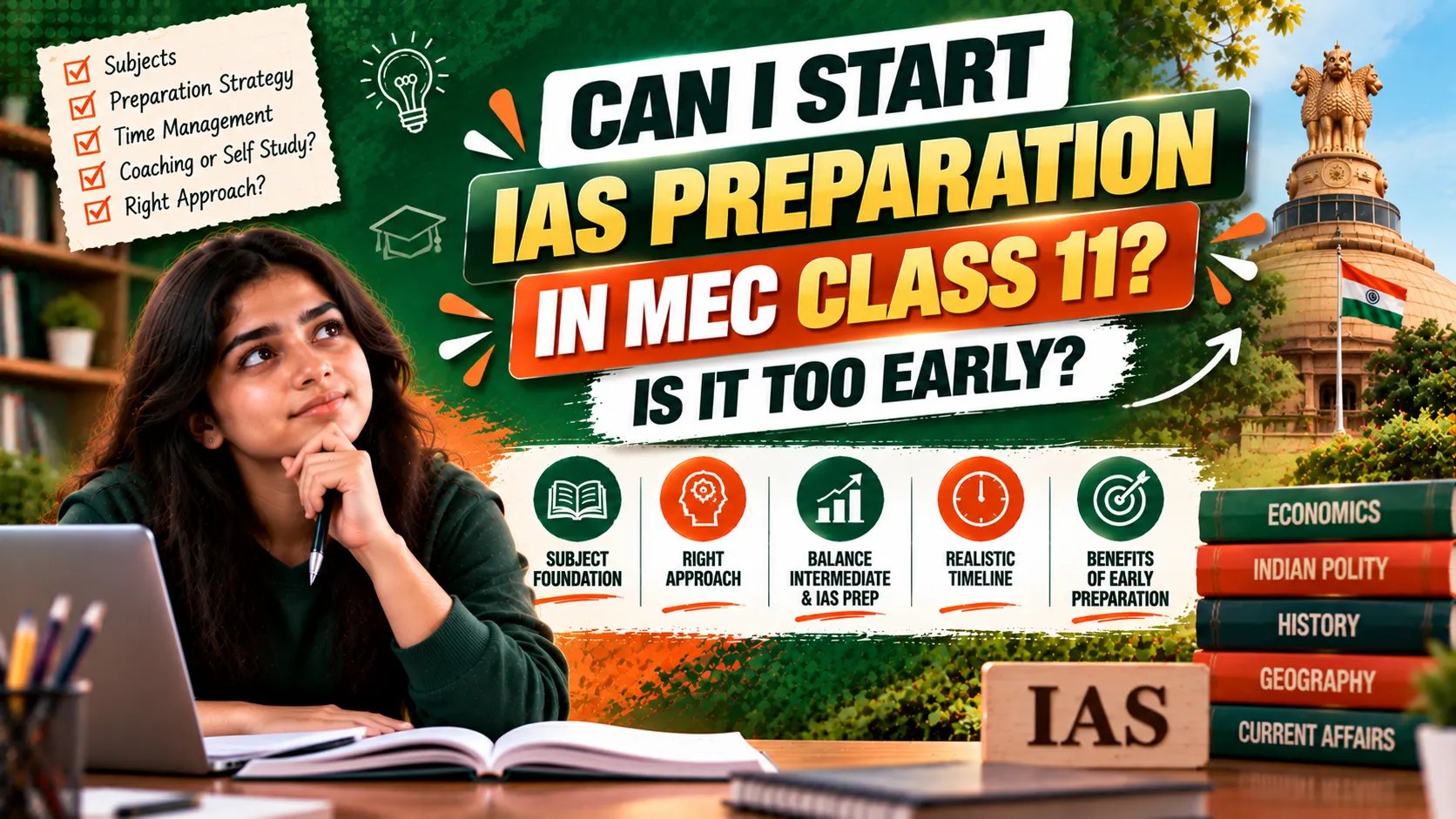
CAN I START IAS PREPARATION IN MEC CLASS 11? IS IT TOO EARLY?
CAN I START IAS PREPARATION IN MEC CLASS 11? IS IT TOO EARLY?
If you are studying MEC in Class 11 and already have an ambition to become an IAS officer, you may be wondering whether you should start preparing now or wait until college.
Class 11 is not too early to start building a foundation for a future civil services journey. However, that does not mean you need to begin full-scale UPSC preparation, study for several hours every day, or immediately work through advanced preparation material.
At this stage, your priority should be your Intermediate education while gradually developing habits such as reading, understanding current events, improving communication and becoming curious about how society, the economy and government function.
SHOULD YOU START IAS PREPARATION IN CLASS 11?
You can start in Class 11, but the way you prepare matters more than how early you begin.
The UPSC Civil Services Examination is attempted much later in a student’s academic journey. Therefore, trying to follow the same preparation schedule as a graduate-level UPSC aspirant during Class 11 may not be necessary.
Instead, use Classes 11 and 12 to create a foundation.
Think of this stage as:
Learn → Read → Understand → Discuss → Build awareness
rather than:
Memorise → Complete UPSC syllabus → Attempt advanced tests
This approach allows you to explore your interest in civil services without compromising your Intermediate studies.
HOW CAN AN MEC STUDENT BEGIN AN IAS FOUNDATION?
MEC students already study Mathematics, Economics and Commerce. Instead of treating IAS preparation as a completely separate academic burden, you can gradually develop complementary skills alongside these subjects.
1. UNDERSTAND ECONOMICS BEYOND THE TEXTBOOK
Economics is one area where your MEC studies can encourage broader awareness.
When you study a concept in class, try connecting it with situations you see around you.
For example, when you come across topics involving inflation, employment, banking or economic growth, ask yourself:
- Why does this happen?
- How does it affect ordinary people?
- What role does the government play?
- How could different sections of society be affected differently?
This approach develops understanding rather than simple memorisation.
2. BUILD A NEWSPAPER READING HABIT
You don’t have to spend hours reading every page of a newspaper.
Start with around 15–20 minutes a day and focus on significant developments.
You can pay attention to topics involving:
- Government and public policy
- Economy
- Environment
- Science and technology
- International developments
- Education
- Important social issues
At this stage, your objective is not to make extensive UPSC notes.
It is simply to understand what is happening around you.
3. STRENGTHEN YOUR GENERAL KNOWLEDGE GRADUALLY
Students sometimes assume that preparing for civil services means memorising hundreds of facts.
A better starting point is developing basic awareness.
Try to understand India’s:
- Geography
- History
- Constitution and political system
- Economy
- Society
- Environment
- Major institutions
You can build this knowledge slowly over Classes 11 and 12 instead of trying to complete everything immediately.
4. IMPROVE YOUR WRITING SKILLS
Civil services preparation eventually requires the ability to understand a question and communicate an answer clearly.
Class 11 is a good time to start strengthening this skill.
Once or twice a week, choose a topic you have read about and write a short explanation in your own words.
For example:
Why is inflation important?
or
Why is water conservation necessary in Indian cities?
Try explaining the topic in 150-200 words.
The objective is not to write a perfect UPSC answer. It is to learn how to organise your thoughts logically.
5. DEVELOP COMMUNICATION SKILLS
An aspiring civil servant should gradually become comfortable expressing ideas clearly.
Students can develop communication skills through:
- Classroom presentations
- Debates
- Group discussions
- Essay writing
- Public speaking
- Reading
- Explaining concepts to others
These activities can improve confidence while also supporting regular academics.
6. USE YOUR MATHEMATICS BACKGROUND TO STRENGTHEN REASONING
Mathematics can help develop structured thinking and problem-solving ability.
Instead of viewing it only as a subject for examinations, use mathematical practice to improve:
- Accuracy
- Logical thinking
- Numerical ability
- Data interpretation
- Problem-solving
- Time management
These skills can remain useful across many competitive examinations and career paths.
WHAT SHOULD YOU STUDY FOR IAS IN CLASS 11?
You do not need a huge collection of UPSC preparation books at this stage.
Start with fundamentals.
A Class 11 student can gradually explore:
Current Affairs: Follow major national and international developments.
Indian Polity: Understand basic ideas about the Constitution, Parliament, elections, fundamental rights and government institutions.
Geography: Build a basic understanding of India and the world using maps.
History: Learn important periods and developments rather than memorising isolated dates.
Economics: Connect your MEC economics syllabus with real-world developments.
Environment: Understand important environmental issues, climate topics and conservation.
The goal should be conceptual understanding, not completing the entire UPSC syllabus before finishing Intermediate.
HOW MUCH TIME SHOULD A CLASS 11 STUDENT SPEND ON IAS PREPARATION?
You don’t need to dedicate several hours every day.
Your Class 11 academics should remain the priority.
A manageable routine could include:
- 15-20 minutes of news reading
- 15-20 minutes of general reading
- One short writing exercise each week
- Occasional discussions about important current issues
- Regular focus on your MEC subjects
Even 30-45 minutes of consistent foundation learning can be more useful at this stage than following an intensive preparation schedule for a few weeks and then stopping.
WHAT SHOULD YOU AVOID IN CLASS 11?
Starting early can be useful, but starting incorrectly can create unnecessary pressure.
DON’T IGNORE YOUR INTERMEDIATE STUDIES
Your immediate academic responsibility is performing well in Classes 11 and 12.
IAS preparation should complement your education, not replace it.
DON’T TRY TO COMPLETE THE ENTIRE UPSC SYLLABUS
There is plenty of time for detailed preparation later.
Focus on understanding fundamentals first.
DON’T COLLECT TOO MANY BOOKS
Having more books does not necessarily mean better preparation.
Build a reading habit before building a large study-material collection.
DON’T MEMORISE CURRENT AFFAIRS WITHOUT UNDERSTANDING THEM
Knowing that something happened is only the first step.
Try to understand why it happened and why it matters.
DON’T COMPARE YOURSELF WITH FULL-TIME UPSC ASPIRANTS
A Class 11 student and a graduate preparing seriously for the Civil Services Examination are at completely different stages.
Your learning strategy should reflect that difference.
A SIMPLE IAS FOUNDATION ROUTINE FOR MEC CLASS 11 STUDENTS
You can keep your routine straightforward.
MONDAY TO FRIDAY
Focus primarily on your regular MEC academics.
Spend a short period reading important news or an informative article.
SATURDAY
Choose one interesting topic from the week and learn more about it.
It could relate to economics, governance, history, geography, science or the environment.
SUNDAY
Write a short summary of one topic in your own words.
You can also review important developments you followed during the week.
This simple routine can gradually improve your knowledge without turning Class 11 into full-time UPSC preparation.
DO YOU NEED IAS COACHING IN CLASS 11?
A Class 11 student does not necessarily need intensive UPSC coaching designed for graduate-level aspirants.
At this age, a structured foundation-oriented approach can be more appropriate.
If students receive additional guidance, it should ideally help them develop areas such as:
- General awareness
- Reading habits
- Current-affairs understanding
- Communication
- Analytical thinking
- Writing
- Academic discipline
The objective should be to develop a strong learner first rather than rush into advanced exam preparation.
WHAT COMES AFTER CLASS 12?
After completing MEC, you can pursue an undergraduate degree based on your interests and eligibility.
Civil services aspirants come from many different educational backgrounds, so you don’t have to choose your degree solely around UPSC.
During graduation, you can gradually move from foundation building towards understanding the examination structure, syllabus and preparation requirements in greater depth.
This creates a natural progression:
Class 11-12: Build foundation and awareness
↓
Graduation: Strengthen subject knowledge and understand UPSC requirements
↓
Serious UPSC Preparation: Follow a structured examination-oriented strategy when appropriate
Starting early should give you more time to develop not more pressure.
TURN YOUR ACADEMIC POTENTIAL INTO A SCHOLARSHIP
Planning your Intermediate education at Gyanville? Take the Gyanville Scholarship Admission Test (GSAT) and get an opportunity to earn a scholarship of up to ₹1,00,000 based on your performance.
Start your Intermediate journey with an opportunity to make your education more affordable.
FINAL THOUGHTS
Starting to think about the IAS journey in MEC Class 11 is not necessarily too early.
What would be too early is treating yourself like a full-time UPSC aspirant and allowing preparation pressure to interfere with your Intermediate education.
Use these two years to become a stronger reader, clearer writer, better communicator and more informed student.
If you develop those habits consistently, you will enter higher education with a foundation that can support not only future civil services preparation but many other academic and career opportunities as well.
Start early but start with the right foundation.

You may also like
WHAT CAREER OPTIONS ARE AVAILABLE AFTER MEC WITH IAS?