
What Makes JEE Main Special? Exam Difficulty, Percentile & Admission Opportunities
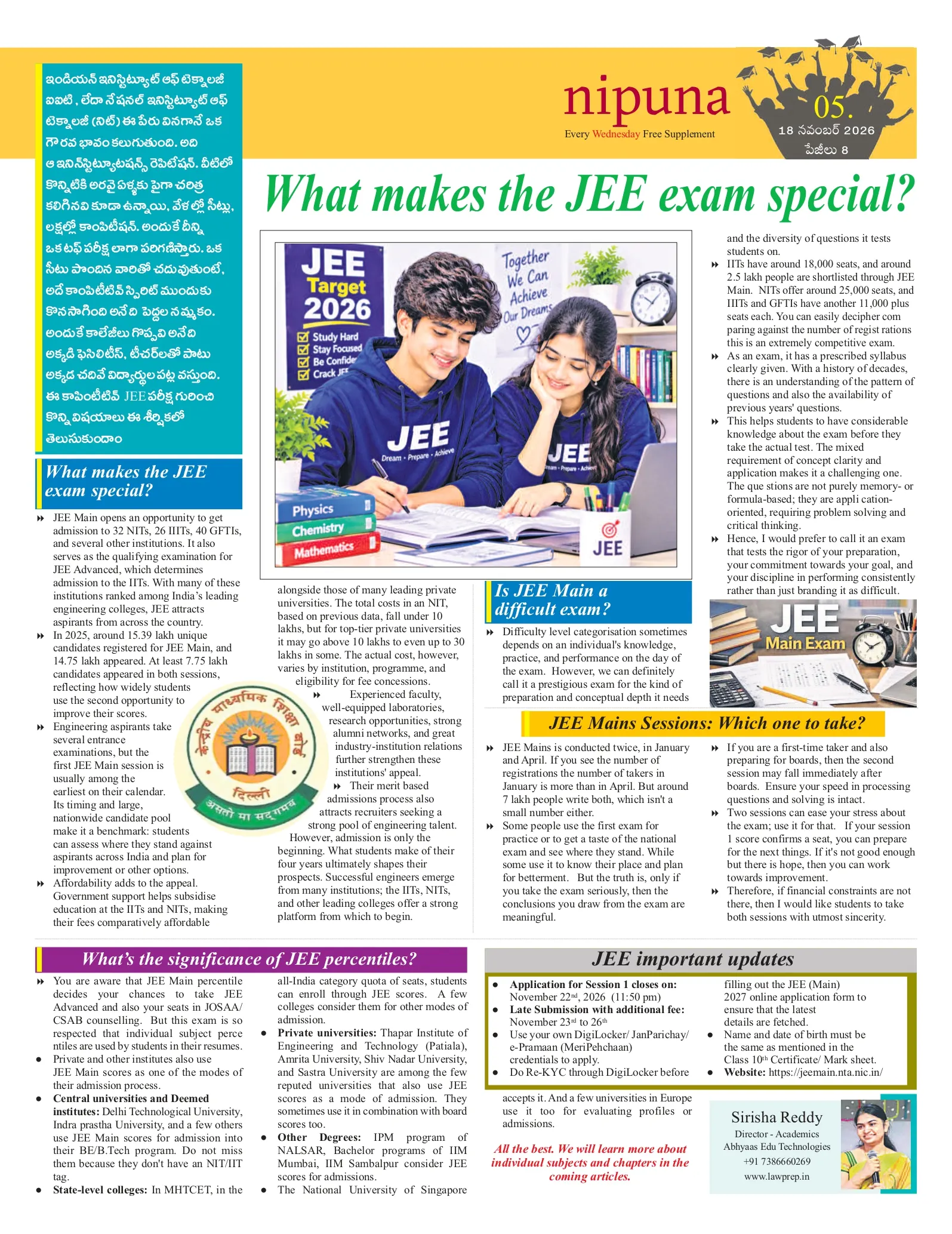
What Makes JEE Main Special? Exam Difficulty, Percentile & Admission Opportunities
The Joint Entrance Examination (JEE) Main is one of India’s most significant engineering entrance examinations. Every year, lakhs of students appear for the exam, hoping to secure admission to prestigious engineering institutions. Beyond testing academic knowledge, JEE Main evaluates problem-solving abilities, conceptual understanding, analytical thinking and the capacity to perform under pressure.
What makes JEE Main special is not merely its competitive nature but the range of educational opportunities it creates. From admission to National Institutes of Technology (NITs) and Indian Institutes of Information Technology (IIITs) to eligibility for JEE Advanced, the examination plays an important role in shaping students’ engineering education.
Why Is JEE Main Important for Engineering Aspirants?
JEE Main provides access to undergraduate engineering programs at 31 NITs, numerous IIITs and Government Funded Technical Institutions (GFTIs), subject to the participating institutions and admission rules for the relevant year.
It also serves as the qualifying examination for JEE Advanced, through which eligible candidates can compete for admission to the Indian Institutes of Technology (IITs).
The examination attracts students from across India, creating a highly competitive environment. However, its importance extends beyond admission to well-known institutions.
Students can use their JEE Main performance to explore engineering opportunities at several other universities and colleges that consider these scores during admission.
Is JEE Main a Difficult Examination?
JEE Main is widely regarded as a challenging entrance examination because it requires a strong understanding of Physics, Chemistry and Mathematics.
Its difficulty does not depend entirely on complicated questions. Students must apply fundamental concepts accurately while managing limited examination time.
Several factors contribute to its competitive nature:
- Conceptual understanding: Questions assess how effectively students apply concepts rather than simply recall formulas.
- Time management: Candidates must balance speed and accuracy while attempting different sections.
- Problem-solving ability: Many questions require logical reasoning and the application of multiple concepts.
- Competition: A large number of well-prepared students compete for a limited number of seats at leading institutions.
Although the examination is demanding, its prescribed syllabus and availability of previous years’ question papers help students understand the expected question patterns.
Consistent preparation, regular revision and mock-test practice can improve examination readiness.
JEE Main January vs April Session: Which Is Better?
JEE Main is generally conducted in two sessions, giving students more than one opportunity to improve their performance.
January Session
The first session allows students to assess their preparation before their Class 12 board examinations or during their preparation year.
Attempting the January session can help candidates identify weaker subjects, understand examination pressure and evaluate their time-management skills.
Students can use their performance to plan improvements before the next session.
April Session
The second session offers another opportunity to candidates who want to improve their scores or could not appear earlier.
However, students preparing for board examinations must manage their schedules carefully, as the second session may take place close to their academic commitments.
Which session should students choose?
Students who are adequately prepared should consider appearing in both sessions. Under the usual JEE Main ranking procedure, the better of the two total NTA scores is considered for candidates appearing in both sessions.
Taking the examination twice can provide valuable experience, but meaningful improvement depends on reviewing mistakes and strengthening preparation.
What Is the Significance of JEE Main Percentile?
The JEE Main percentile is an important measure used to evaluate a candidate’s relative performance.
Unlike a percentage, which indicates marks obtained out of the maximum available marks, a percentile reflects performance relative to other candidates in the relevant examination session.
For example, a 95 percentile indicates that the candidate performed as well as or better than approximately 95% of candidates in the comparison group.
The National Testing Agency (NTA) uses a normalisation process to account for differences between examination shifts.
JEE Main percentile scores play an important role in determining ranks and eligibility for admission through participating counselling systems.
However, admission also depends on factors such as category, seat availability, institutional eligibility requirements and counselling preferences.
Admission Opportunities Beyond IITs and NITs
One important advantage of JEE Main is that its scores can be useful beyond the centrally funded engineering institutions.
Several private universities and other higher education institutions consider JEE Main performance as part of their admission procedures.
Institutions such as Thapar Institute of Engineering and Technology, Amrita Vishwa Vidyapeetham and Shiv Nadar University have offered admission pathways involving JEE Main scores, subject to their current policies.
Some universities may also consider JEE scores for selected interdisciplinary or other undergraduate programs.
Students should review each institution’s official admission guidelines before applying, as eligibility criteria and accepted examination scores can change.
How to Prepare Effectively for JEE Main
Successful preparation requires consistency, disciplined study habits and a clear understanding of the syllabus.
Students should focus on building strong fundamentals in Physics, Chemistry and Mathematics before progressing to complex problems.
Regular mock examinations help candidates become familiar with the examination format and identify areas requiring improvement.
Analysing mistakes is equally important. Students should review incorrect answers, understand conceptual gaps and practise similar questions.
A balanced study schedule, adequate rest and realistic preparation targets can help maintain performance throughout the preparation period.
Dreaming of IIT? Start Your Journey After Class 10!
Build a strong foundation for JEE Main and Advanced with Gyanville Academy’s MPC + IIT Integrated Programme. Take the MPC + IIT Scholarship Test and explore scholarship opportunities for your intermediate education and IIT preparation.
JEE Main 2027: Important Updates
Session 1 applications close on 22 November 2026 at 11:50 pm, and a late submission with an additional fee is allowed from 23 to 26 November.
- Use your own DigiLocker, JanParichay or e-Pramaan credentials to apply.
- Complete Re-KYC through DigiLocker before filling in the online form.
- Your name and date of birth must match your Class 10 certificate or mark sheet.
Students should confirm all registration deadlines, examination dates, application requirements and official announcements directly through the NTA website before taking action.
Official website: https://jeemain.nta.nic.in/
Conclusion
JEE Main is more than a competitive engineering entrance examination. It provides students with access to respected institutions, multiple admission pathways and opportunities to evaluate their academic capabilities.
Its emphasis on conceptual clarity, analytical thinking and consistent preparation makes it an important milestone for engineering aspirants.
Rather than focusing only on the examination’s difficulty, students should approach JEE Main as an opportunity to demonstrate their knowledge, improve their performance and work towards their higher education goals.

You may also like

CLAT 2027 English and Logical Reasoning Preparation Tips