JEE Main Mathematics: Chapter-Wise Weightage, Syllabus Changes & Preparation Strategy
JEE Main Mathematics: Chapter-Wise Weightage, Syllabus Changes & Preparation Strategy
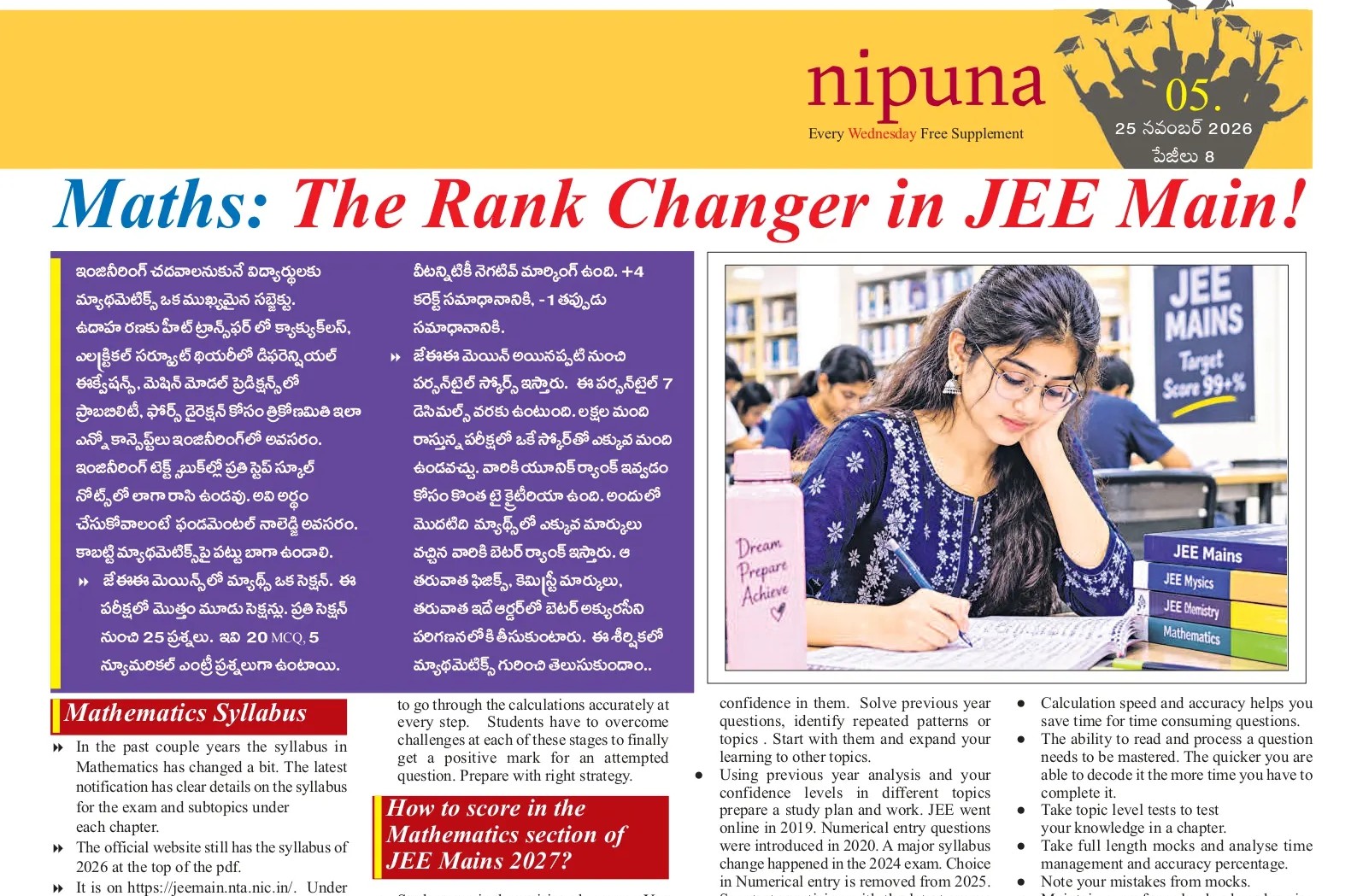
Mathematics can be a deciding factor in achieving a competitive JEE Main rank. While understanding formulas is essential, the examination demands much more than theoretical knowledge. Students must develop analytical thinking, numerical accuracy and the ability to recognise suitable problem-solving methods under time constraints.
With JEE Main 2027 approaching, aspirants should focus on understanding examination trends, identifying important chapters and developing a structured revision strategy that maximises their scoring potential.
Why Is Mathematics Important in JEE Main?
Mathematics contributes 100 marks out of the 300 marks in JEE Main Paper 1. A strong performance in this subject can significantly improve a student’s overall score.
Mathematics performance also plays a role in the examination’s tie-breaking procedure, subject to the applicable NTA guidelines.
Beyond entrance examinations, mathematical knowledge provides a foundation for engineering disciplines such as computer science, artificial intelligence, electronics, mechanical engineering and data science.
Students should therefore approach Mathematics as a skill-building subject rather than simply an examination requirement.
JEE Main Mathematics Syllabus and Exam Pattern Changes
Understanding recent changes helps students prepare using relevant study materials and avoid practising topics outside the prescribed syllabus.
The Mathematics syllabus underwent significant revisions in 2024. From 2025, the optional question format in the numerical answer section was discontinued.
The recent examination pattern is outlined below:
| Particulars | Details |
|---|---|
| Multiple-choice questions | 20 |
| Numerical value-based questions | 5 |
| Total questions | 25 |
| Maximum marks | 100 |
| Correct answer | +4 marks |
| Incorrect answer | −1 mark |
| Unattempted question | 0 marks |
Students should compare their preparation materials with the latest syllabus and examination bulletin available on the official JEE Main website.
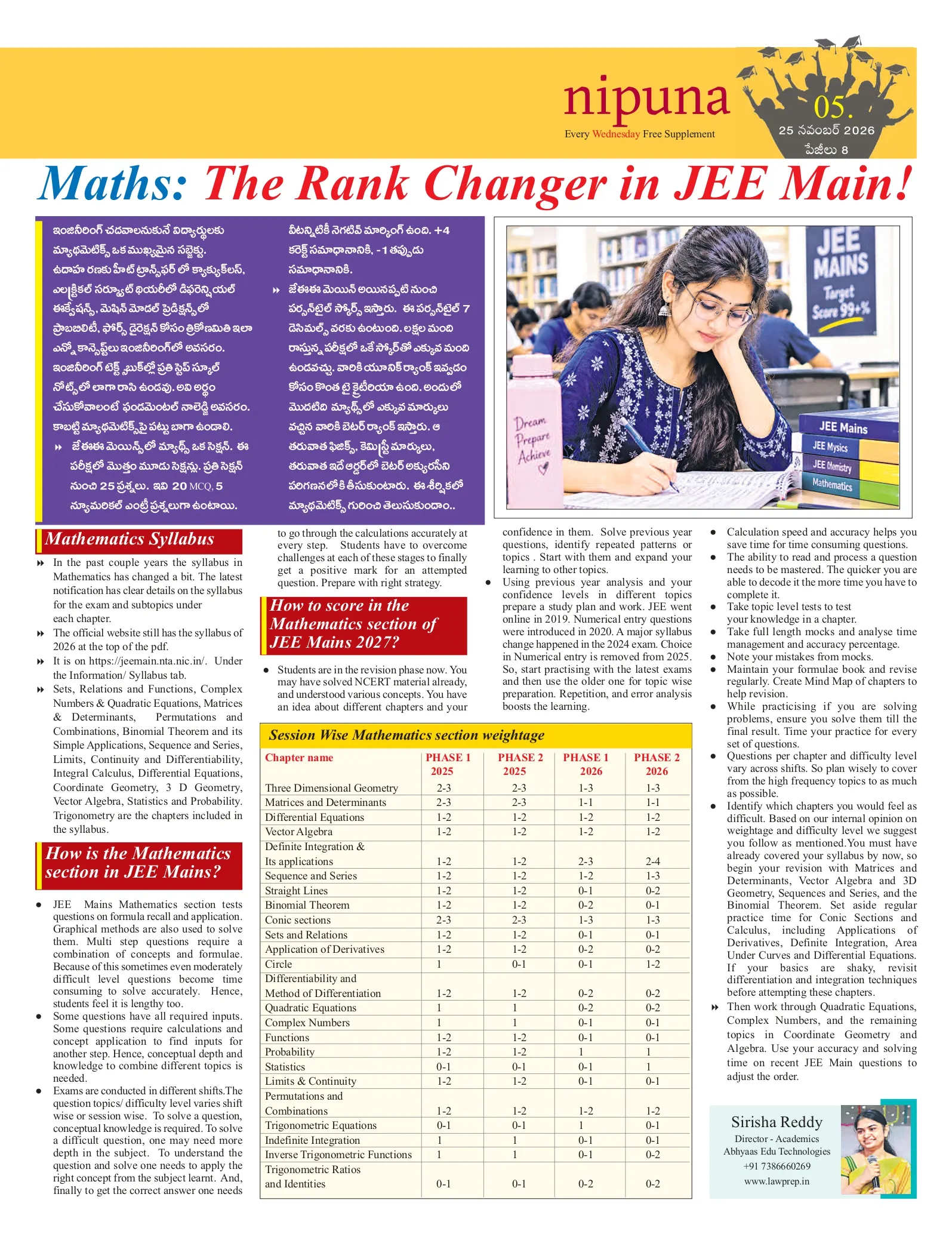
JEE Main Mathematics Chapter-Wise Weightage
Previous examination trends provide useful insights into the frequency of questions from different chapters. However, question distribution varies across sessions and shifts.
Based on the 2025 and 2026 examination analysis , the following chapters deserve particular attention.
| Important Chapter | 2025 Question Range | 2026 Question Range |
|---|---|---|
| Three-Dimensional Geometry | 2–3 | 1–3 |
| Definite Integration and Applications | 1–2 | 2–4 |
| Conic Sections | 2–3 | 1–3 |
| Matrices and Determinants | 2–3 | 1 |
| Vector Algebra | 1–2 | 1–2 |
| Differential Equations | 1–2 | 1–2 |
| Sequences and Series | 1–2 | 1–3 |
| Permutations and Combinations | 1–2 | 1–2 |
| Probability | 1–2 | 1 |
These figures represent historical question-count ranges across the reported sessions and should not be treated as guaranteed weightage for JEE Main 2027.
The increased presence of Definite Integration questions in the reported 2026 sessions highlights the importance of strengthening Calculus fundamentals.
How to Prioritise JEE Main Mathematics Chapters
Instead of preparing chapters solely according to weightage, students should consider conceptual difficulty, preparation time and personal accuracy.
Build Scoring Confidence
Begin with relatively structured topics such as Matrices and Determinants, Vector Algebra, Three-Dimensional Geometry and Sequences and Series.
Regular practice can help students recognise familiar question patterns and improve solving efficiency.
Strengthen Concept-Intensive Topics
Calculus, Conic Sections, Complex Numbers and Permutations and Combinations require deeper conceptual understanding.
Students should divide these chapters into smaller topics and practise different question models before attempting mixed problems.
Revise Supporting Topics
Trigonometry, Functions, Quadratic Equations, Limits and Continuity should not be neglected. These concepts frequently support problem-solving in other areas of Mathematics.
Why Accuracy Matters More Than Blind Attempts
Attempting more questions does not necessarily result in a higher score. Negative marking makes question selection particularly important.
Consider the following example:
| Performance | Student A | Student B |
|---|---|---|
| Questions attempted | 20 | 17 |
| Correct answers | 14 | 15 |
| Incorrect answers | 6 | 2 |
| Final score | 50 | 58 |
Although Student B attempted fewer questions, better accuracy resulted in a higher Mathematics score.
This demonstrates why students should avoid unnecessary guessing and prioritise questions they can solve confidently.
30-Day JEE Main Mathematics Revision Plan
Students who have completed most of their syllabus can follow a structured revision schedule during the final month.
| Duration | Preparation Focus |
|---|---|
| Days 1–7 | Matrices, Determinants, Vector Algebra, 3D Geometry and Sequences |
| Days 8–14 | Differentiation, Integration, Applications of Derivatives and Differential Equations |
| Days 15–21 | Coordinate Geometry, Complex Numbers, Probability and remaining Algebra topics |
| Days 22–26 | Mixed chapter tests, previous years’ questions and weak-topic revision |
| Days 27–30 | Full-length mock tests, formula revision and error analysis |
This schedule can be adjusted according to individual preparation levels and performance in mock examinations.
Effective JEE Main Mathematics Preparation Strategies
Practise Active Recall
Instead of repeatedly reading formulas, close the textbook and attempt to recall important identities, properties and solution methods independently.
Use Spaced Revision
Revisit difficult concepts at regular intervals. Reviewing a topic after one day, three days and one week can help strengthen long-term retention.
Maintain an Error Notebook
Classify mistakes into conceptual errors, calculation mistakes, incorrect formula selection and question misinterpretation. Reattempt incorrect questions periodically.
Develop a Question Selection Strategy
During mock examinations, attempt familiar and manageable problems first. Return to lengthy or challenging questions after completing the more accessible ones.
Analyse Mock Test Performance
Track accuracy, time spent per question, unattempted questions and marks lost through negative marking. Use these observations to improve subsequent attempts.
Common Mistakes to Avoid During Mathematics Preparation
- Depending entirely on high-weightage chapters.
- Memorising formulas without understanding their applications.
- Watching solution videos without solving questions independently.
- Practising difficult problems while neglecting basic concepts.
- Taking mock tests without reviewing mistakes.
- Spending excessive time on a single examination question.
Avoiding these habits can make preparation more productive and improve examination confidence.
Your IIT Journey Begins with a Strong Foundation!
Strengthen your Mathematics, Physics and Chemistry fundamentals with Gyanville Academy’s MPC + IIT Integrated Programme after Class 10.Take the MPC + IIT Scholarship Test and explore scholarship opportunities for your intermediate education and JEE preparation.
Frequently Asked Questions
1. Which Mathematics chapters are important for JEE Main 2027?
Three-Dimensional Geometry, Vector Algebra, Definite Integration, Conic Sections, Matrices and Determinants are important revision priorities based on previous examination trends.
2. Is NCERT enough for JEE Main Mathematics?
NCERT provides a useful conceptual foundation. However, students should supplement it with JEE-level problems, previous years’ questions and timed mock tests.
3. Can I score 70 marks in JEE Main Mathematics?
Yes. For example, answering 18 questions correctly and two incorrectly results in 70 marks. Achieving this requires strong conceptual preparation, accuracy and effective question selection.
Conclusion
Success in JEE Main Mathematics depends on how effectively students convert conceptual knowledge into accurate solutions. Historical chapter-wise weightage can guide revision priorities, but comprehensive syllabus coverage remains important.
A balanced approach combining systematic revision, timed practice, error analysis and intelligent question selection can help aspirants improve their Mathematics performance and work towards a competitive JEE Main rank.

You may also like

CLAT 2027 English and Logical Reasoning Preparation Tips