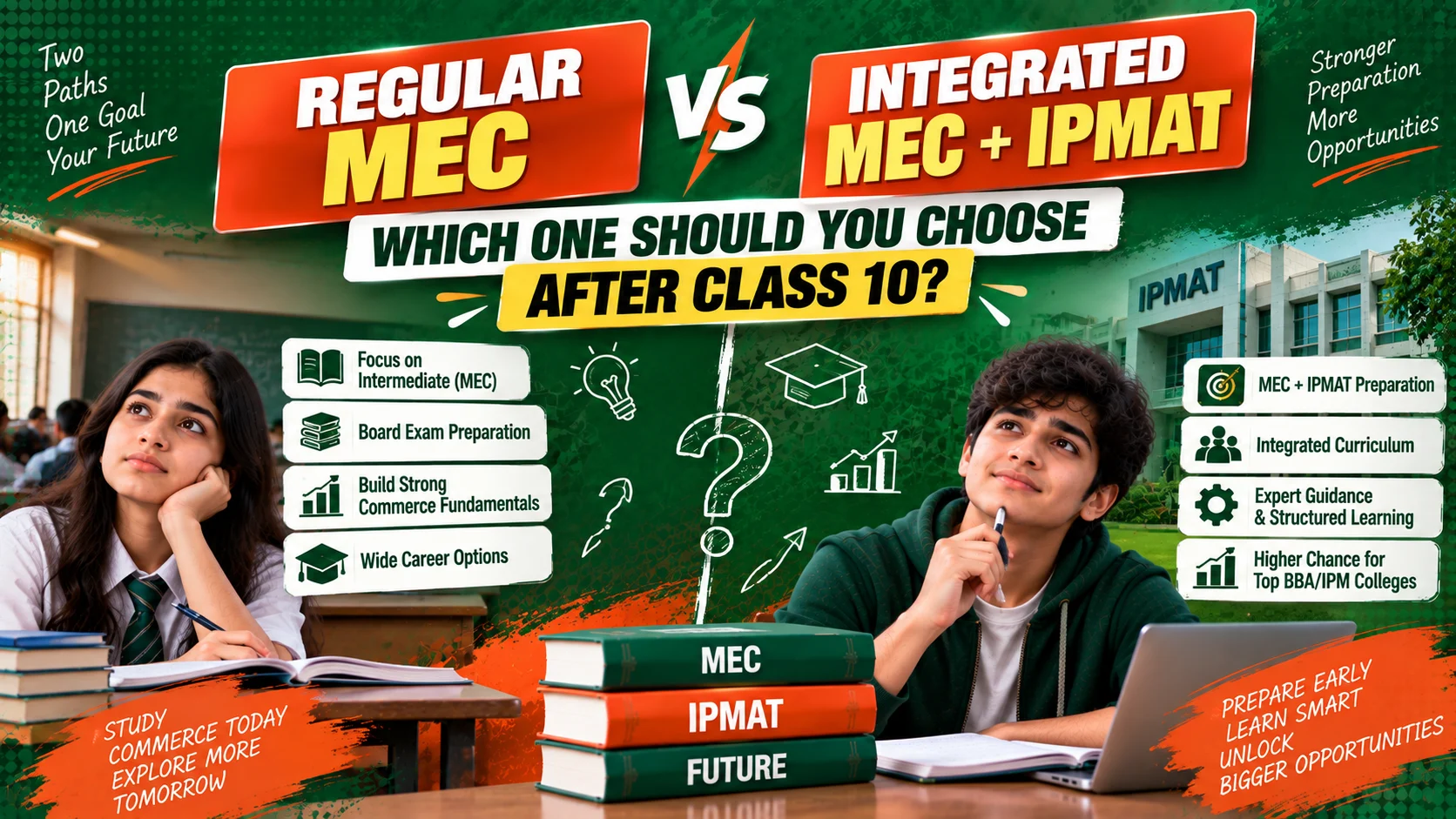
REGULAR MEC VS INTEGRATED MEC + IPMAT: WHICH ONE SHOULD YOU CHOOSE AFTER CLASS 10?
REGULAR MEC VS INTEGRATED MEC + IPMAT: WHICH ONE SHOULD YOU CHOOSE AFTER CLASS 10?
After Class 10, choosing an Intermediate stream is more than deciding which subjects you want to study for the next two years. For students interested in management, business, economics or an IIM, another question often comes up:
Should I take regular MEC and prepare for IPMAT separately, or choose a programme that combines MEC with IPMAT preparation?
Both routes can work. The difference is mainly in how your two years are structured, when you begin entrance preparation and how you manage your academic and competitive-exam workload.
MEC stands for Mathematics, Economics and Commerce and is one of the Intermediate combinations available under the Telangana State Board.
IPMAT, meanwhile, is an entrance route used by institutions including IIM Indore for their five-year Integrated Programme in Management. For the 2026 admission cycle, IIM Indore’s eligibility required candidates to have passed Class 10 and Class 12/equivalent, with the qualifying Class 12 requirement applying to students who had completed or were appearing for it in the specified years.
So, what does the choice between regular MEC and MEC + IPMAT preparation actually mean?
Let us break it down.
FIRST, WHAT IS REGULAR MEC?
In a regular MEC programme, your primary focus is on the Intermediate academic curriculum.
You study:
- Mathematics
- Economics
- Commerce
- Other subjects required by your board and institution
Your main academic schedule is built around classroom teaching, assignments, examinations and board preparation.
If you decide later that you want to attempt IPMAT, you can prepare for the entrance examination separately through self-study, online learning or an external coaching programme.
This gives you flexibility because your Intermediate studies and entrance preparation can be planned independently.
For example, you may need to decide:
- When to start IPMAT preparation
- Which topics to study first
- How much time to give to aptitude practice
- When to take mock tests
- How to balance entrance preparation with Intermediate examinations
For students who are comfortable creating and following their own study schedule, this can be a workable approach.
WHAT DOES INTEGRATED MEC + IPMAT MEAN?
An integrated MEC + IPMAT programme combines the regular Intermediate MEC curriculum with structured preparation for management entrance examinations.
Instead of treating the two as completely separate activities, the academic and entrance preparation are planned within the same overall schedule.
The idea is to work on two goals during the same two-year period:
Intermediate academics + IPMAT preparation
A typical integrated approach may include areas such as:
- Mathematics
- Economics
- Commerce
- Quantitative Ability
- Verbal Ability
- Logical reasoning or related aptitude skills
- Practice tests
- Mock examinations
- Performance analysis
The exact subjects, timetable and preparation methods depend on the institution offering the programme.
The main difference is therefore not that one option contains “MEC” and the other does not. Both can include MEC.
The difference is whether IPMAT preparation is built into the academic routine or handled separately.
REGULAR MEC VS INTEGRATED MEC + IPMAT
Here’s what sets regular MEC and integrated MEC + IPMAT apart.
| Factor | Regular MEC | Integrated MEC + IPMAT |
|---|---|---|
| Intermediate subjects | MEC curriculum | MEC curriculum |
| IPMAT preparation | Usually separate | Included within the programme |
| Study schedule | Mainly academic | Academics + entrance preparation |
| External coaching | May be considered separately | May not be necessary, depending on the programme |
| Preparation start | Depends on the student | Usually begins as part of the programme |
| Mock-test practice | Student arranges separately | Generally incorporated into the schedule |
| Time management | Student manages both separately | Academic and entrance preparation are planned together |
| Flexibility | More flexibility to design your own preparation | More structured routine |
| Best suited to | Students comfortable planning independently | Students who prefer a planned preparation system |
This comparison does not mean one route works for every student. Your choice should depend on your learning style, goals and how much structure you want during Classes 11 and 12.
WHEN CAN REGULAR MEC MAKE SENSE?
Regular MEC may suit a student who wants to keep multiple options open without committing to an entrance-focused routine immediately.
For example, you may be interested in:
- Commerce
- Economics
- Finance
- Management
- Professional courses
- Undergraduate business programmes
- Other academic pathways
You may also prefer studying the Intermediate curriculum first and deciding later how much competitive-exam preparation you want to add.
Another consideration is independence.
If you are comfortable researching the IPMAT syllabus, finding study material, creating a timetable and tracking your own progress, separate preparation may be manageable.
The important point is to avoid postponing the decision simply because IPMAT preparation is separate. If IPMAT is already a serious goal, you should understand the preparation requirements early.
WHEN CAN INTEGRATED MEC + IPMAT BE USEFUL?
An integrated programme can be useful for students who already have a clear interest in management entrance examinations and prefer having their preparation organised within their regular academic routine.
Instead of attending Intermediate classes during the day and arranging separate coaching around them, the preparation can be planned as part of one broader schedule.
This can help students work consistently on areas that are different from their school subjects.
For instance, Intermediate Mathematics and IPMAT Quantitative Ability may overlap in some concepts, but entrance preparation also requires practice in speed, application and unfamiliar problem formats.
Similarly, studying English as part of regular academics is different from deliberately preparing for an aptitude test’s verbal section.
An integrated structure can bring these different preparation requirements into one timetable.
WHAT ABOUT STUDENTS WHO ARE NOT SURE ABOUT IPMAT?
This is an important point.
Not every Class 10 student needs to decide their entire career path immediately.
You might currently be thinking about management but still be unsure whether you will eventually attempt IPMAT.
In that situation, look carefully at what the programme actually includes.
Ask:
- Can I continue with other academic interests?
- Does the programme provide sufficient focus on Intermediate subjects?
- How much additional entrance preparation is included?
- Is the daily schedule suitable for me?
- What happens if I later decide not to attempt IPMAT?
The right choice should leave you with an academic foundation that remains useful even if your plans change.
DOES CHOOSING MEC GUARANTEE AN IPMAT PATH?
No.
Choosing MEC after Class 10 does not guarantee admission to an IIM or any other management programme.
MEC can provide relevant academic exposure, particularly because Mathematics develops quantitative skills and Economics and Commerce introduce students to business-related concepts.
But admission to an IPM programme depends on the eligibility requirements and selection process of the institution you apply to.
For example, IIM Indore’s current IPM admission process includes an entrance test and subsequent selection stages; the exact requirements can change by admission year.
Therefore, choosing MEC should be viewed as building an academic foundation, not as securing an admission outcome.
HOW IS IPMAT PREPARATION DIFFERENT FROM MEC ACADEMICS?
This is one of the biggest differences students should understand before choosing an integrated programme.
MEC gives you academic subjects.
IPMAT preparation adds an entrance-exam dimension.
For example, Mathematics in Intermediate may require you to understand concepts and prepare for your board examinations. IPMAT preparation may require you to use mathematical concepts in shorter, application-oriented questions where speed and accuracy become important.
Similarly, IPMAT preparation can involve areas outside your regular MEC subjects.
You may need to work on:
- Quantitative problem-solving
- Verbal ability
- Reading comprehension
- Logical reasoning
- Data interpretation
- Time management
- Mock-test strategy
Therefore, an integrated programme is not simply “MEC with extra Maths.”
It is a combination of academic study and entrance-oriented preparation.
WHAT HAPPENS IF YOU CHOOSE REGULAR MEC AND START IPMAT PREPARATION LATER?
You can still prepare for IPMAT.
There is no requirement that a student must take an integrated MEC + IPMAT programme to pursue IPMAT.
The key consideration is how much time you have and how you organise that time.
A student following regular MEC may create a separate preparation plan:
Intermediate studies → IPMAT self-study/coaching → Practice → Mock tests → Revision
This can work if the student follows the plan consistently.
The challenge is that you may have to coordinate multiple schedules yourself.
WHAT HAPPENS IF YOU CHOOSE INTEGRATED MEC + IPMAT?
Your preparation is generally organised around both academic and entrance goals from the beginning.
A possible routine could look like:
MEC classroom learning → Concept practice → IPMAT aptitude session → Practice questions → Review
The exact structure varies from one institution to another, so students should look beyond the word “integrated” and understand what is actually included.
Before enrolling, ask about:
- Daily timetable
- Faculty
- Entrance-exam coverage
- Mock-test frequency
- Doubt support
- Academic assessments
- Study material
- Individual feedback
- Revision schedule
This gives you a clearer picture of what you are actually choosing.
WHICH OPTION SHOULD YOU CHOOSE AFTER CLASS 10?
There is no universal answer.
Think about your current situation.
REGULAR MEC MAY SUIT YOU IF:
- You want flexibility in your academic path.
- You are comfortable preparing independently.
- You are not yet certain about IPMAT.
- You prefer arranging entrance preparation separately.
- You can maintain a consistent study schedule on your own.
INTEGRATED MEC + IPMAT MAY SUIT YOU IF:
- You already have a strong interest in management entrance exams.
- You prefer a structured timetable.
- You want Intermediate academics and IPMAT preparation planned together.
- You want regular entrance-oriented practice.
- You find it difficult to manage separate academic and coaching schedules.
These are not strict rules. A student’s learning habits and long-term plans can change during Classes 11 and 12.
QUESTIONS TO ASK BEFORE SELECTING A PROGRAMME
Do not make your decision based only on the name of the course.
Before choosing between regular MEC and an integrated programme, ask the institution:
1. What does the daily timetable look like?
A programme may say it is integrated, but the actual number of hours dedicated to entrance preparation matters.
2. How are board academics handled?
Your Intermediate performance remains important, so understand how the programme balances academic preparation with entrance training.
3. Which IPMAT areas are covered?
Check whether the programme includes only Quantitative Ability or also covers verbal ability, reading comprehension, reasoning and mock-test practice where relevant.
4. How frequently are students tested?
Regular testing can help students identify gaps, but understand whether tests are followed by meaningful analysis and feedback.
5. What happens if your plans change?
A two-year programme should provide value beyond one entrance examination.
6. How much independent study is expected?
Even with an integrated programme, students will still need individual practice and revision.
DO NOT CHOOSE ONLY BECAUSE THE WORD “INTEGRATED” SOUNDS BETTER
The word “integrated” describes a structure. It does not by itself tell you how effective the programme will be for an individual student.
Look at the actual academic system.
Consider:
Curriculum + Faculty + Timetable + Practice + Assessment + Mentoring
Then compare that with your own learning preferences.
Similarly, regular MEC should not be dismissed simply because IPMAT preparation is separate. A disciplined student can build an independent preparation plan and use external resources when required.
The real question is not:
“Which option is better for everyone?”
It is:
“Which study structure matches the way I learn and the goals I currently have?”
CONCLUSION
Regular MEC and integrated MEC + IPMAT are two different ways of organising the same important two-year academic stage.
With regular MEC, you can focus on your Intermediate studies and arrange IPMAT preparation separately according to your needs. With integrated MEC + IPMAT, academic learning and entrance preparation are planned together within a more structured system.
If you already have a clear interest in management entrance exams and prefer a guided routine, an integrated approach may fit your study style. If you value flexibility or want more time before committing to entrance preparation, regular MEC with separate preparation may be more suitable.
The decision does not have to be based on what sounds more impressive. Look at the subjects, timetable, preparation system, academic support and your own learning habits before making your choice.
Check Your Academic Preparation with the Gyanville Scholarship Test
Before choosing your Intermediate pathway, understand your current academic level and where you may need to focus as you plan your next academic step.

You may also like
MEC VS MPC FOR IPMAT: WHAT SHOULD A STUDENT CHOOSE AFTER CLASS 10?